Five Stages of Grief After Any Kind of Loss

By Catriona Standingford MBACP, MNCPS (Acc.)

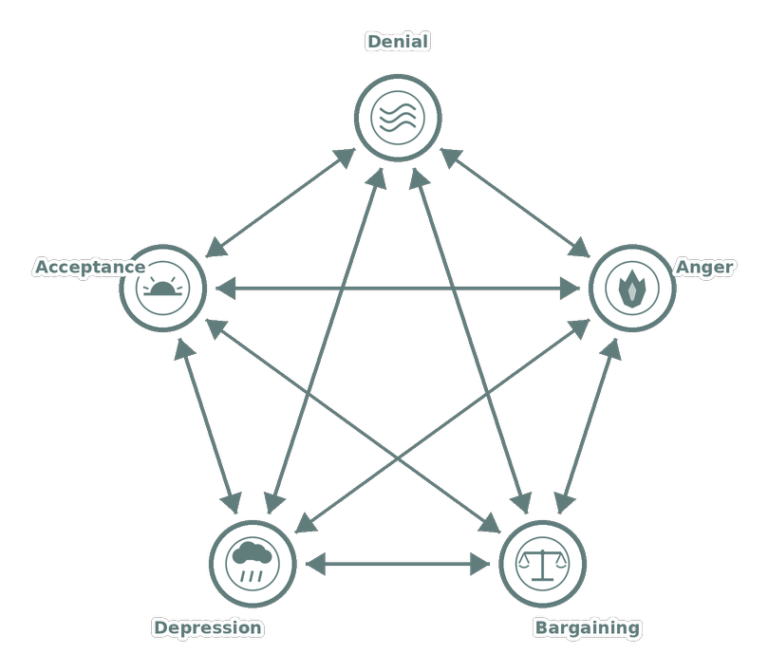
The five stages of grief from the Kübler-Ross model are denial, anger, bargaining, depression and acceptance. They describe responses many people feel after a loss, whether that be the death of a loved one or a different kind of loss such as losing a friendship. You might move between these stages, re-visit stages or be feeling more than one aspect at once.

A lit candle on a windowsill beside a small bunch of white daisies
Photo by Esra Korkmaz on Unsplash

Key points

  • Many people move back and forth between the five stages, sometimes for years.
  • The same feelings can follow losses that aren’t a death, such as estrangement.
  • Acceptance usually means learning to live with the loss, rather than the grief disappearing.
Diagram of the five stages of grief, denial, anger, bargaining, depression and acceptance, with arrows running in both directions between every stage
Diagram © Catriona Standingford

What are the five stages of grief?

The five stages of grief are denial, anger, bargaining, depression and acceptance, and each one can feel very different. We often talk about five stages because they give names to feelings which can help us to understand and process them. The psychiatrist Elisabeth Kübler-Ross described them in 1969, after working with people who were dying, but today they are applied to other types of loss too.

Denial – “This can’t be true”

Denial is a protective fog when you’re not ready to start looking at and accepting the reality. Part of you knows what has happened, but part of you isn’t ready to sit with that knowledge. So you may find yourself carrying on with the washing, the school run and the work emails as if nothing has changed.

Denial is often the first response to a loss, and it can feel like numbness or shock rather than a choice you’re making. You might feel strangely calm at the funeral, keep telling people “I’m fine”, or half expect them to walk through the door at teatime. Some people keep sending messages to a phone that will never be answered, or put off telling others because saying it out loud makes it real. With losses that aren’t a death, denial can look like telling yourself an estrangement is ‘just a blip’, or putting a parent’s growing forgetfulness down to tiredness. It can come back later too, when a new reminder of the loss catches you off guard.

What may help: let the reality in a little at a time. Saying what has happened out loud, even just to yourself (“Mum has died” or “We’re not speaking”), can help it start to feel real. Small steps such as reading the cards, sorting a few of their things or telling one more person can do the same, at a pace that feels manageable. If the numbness goes on for a long time, talking it through with someone can help you start to feel what’s underneath it.

Anger – “Why did this happen?”

Anger can come out in many different ways. It can be pointed at a person, yourself or simply the unfairness of the event. You may snap at your partner over the dishwasher, or perhaps yell at anyone who happens to cross your path. You might feel angry with the doctors, with a sibling who didn’t visit, or with the person who has died for leaving you.

What may help: anger needs somewhere to go. Writing a letter you can never send, or saying out loud how angry you feel to someone who won’t judge you can help let some of it out. Being angry with someone you loved who has died or who you have lost in another way, doesn’t cancel out the love.

Bargaining – “If only…”

Bargaining is replaying what might have changed things and perhaps wishing you had done something differently. It’s an attempt to find control in a situation where there may be no control left. You might go over the last few weeks again and again: if only I’d noticed sooner, if only I’d made that call. Or an old photo pops up in your feed of the brother you once had a relationship with, and you feel kicked in the gut. Before long you’re going over that last argument, wondering what you could have said instead.

What may help: notice when you’re in the ‘if only’ place, and ask yourself whether you knew then what you know now. Usually you didn’t. Talking the ‘what ifs’ through with someone can make them easier to put down.

Depression – “What’s the point?”

This stage is low mood and withdrawal, as you come to grips with the change. You might lose interest in things you used to enjoy, cancel plans, or find that getting dressed takes everything you’ve got. It may appear in your life later than expected, when everyone else seems to have moved on. It’s a natural part of grief and loss, and it isn’t necessarily the same as clinical depression, although the two can overlap.

What may help: keep things small. One phone call, one walk, one meal with someone. If the low mood doesn’t lift, or you’re struggling to get through the day, it’s worth talking to your GP as well as a counsellor.

Acceptance – “Learning to carry it”

Acceptance is finding a way to hold the loss with an acceptance that things have changed. It doesn’t mean you’re fine with what happened, or that the grief has gone. It might look like being able to talk about your dad and smile, or walking past the café you used to visit with an old friend without crossing the road. If your loss is related to losing a friendship rather than the death of someone, acceptance may mean coming to terms with the loss of that relationship for now, rather than giving up on it.

What may help: let acceptance come and go. You might feel it one week and be back in anger the next. Marking the loss in your own way, such as planting something or keeping a photo out, can help you carry it.

Do the stages of grief happen in order?

Very rarely. The stages aren’t a straight line, and most people move between them unpredictably, feeling two at once or doubling back to one they thought they’d left behind.

A song in the supermarket, the smell of a particular perfume, or a birthday card you’d once have posted can bring anger or denial back years later. Going back to a stage you thought you’d left isn’t a setback. It’s simply how grief can move.

Sadly support for grief and loss can be hard to find. The UK Commission on Bereavement’s 2022 report found that over 40% of adult respondents who wanted formal bereavement support didn’t get any.

How can you cope when grief keeps changing?

Alongside the ideas for each stage above, a few things can help whatever stage you’re in, and grief does tend to become easier to live with over time.

Name what’s there

Saying “I’m in the ‘if only’ place again” can help. It won’t make the feeling go, but it can stop it knocking you off-balance.

Plan for the hard dates

Anniversaries, birthdays and Christmas often bring grief and loss back up. You might decide ahead of time who you’ll be with, or let yourself do very little that day.

Talk it through

Sometimes the feelings are too tangled to sort out alone, or people seem to expect you to have ‘moved on’. Talking to a counsellor who works with grief and loss can give you the space and support to process your thoughts and feelings at your own pace.

Can you grieve in stages when no one has died?

Yes. The same stages can follow losses with no funeral and no clear ending, such as a parent whose dementia has changed who they are or a family member who has become estranged. This is sometimes called ambiguous loss: grieving someone who is still, in some sense, here.

Bargaining might mean hoping things will change. If you’re a parent whose adult child has stepped back from you, my post on adult children cutting off contact may help.

And if you’re supporting someone who is grieving, try not to expect a particular stage at a specific time. Ask how today is, and listen.

Frequently asked questions

How long do the five stages of grief last?

There’s no set timescale for the five stages of grief. For many people the feelings soften over months or years, then return around anniversaries.

Can you skip a stage of grief?

Yes. Some people barely notice one or more of the stages, and that doesn’t mean they’re grieving ‘wrong’. We’re all different.

Who came up with the five stages of grief?

The psychiatrist Elisabeth Kübler-Ross described the five stages in her 1969 book On Death and Dying, based on her work with people who were dying.

Finding support

I’m a trauma-informed counsellor working with adults, online and face to face in Chepstow, South East Wales, and I support people grieving a death as well as losses such as family estrangement.

You can check my registration on the BACP Register and the NCPS Register, and it’s always worth checking that whoever you see is registered.

Cruse Bereavement Support runs a free helpline on 0808 808 1677. If you’re struggling to keep yourself safe, call Samaritans any time on 116 123, or 999 in an emergency.

Last updated 16 November 2026

Would it help to talk?

Grief and loss rarely follow a set path, and it can help to have someone to hear your anger, sadness, the ‘if onlys’ and the days that feel difficult for no obvious reason.

Let’s have a free 15 minute chat, with no pressure to book afterwards. Email me at cs@catrionastandingford.co.uk, WhatsApp or text 07564 069711, or use my contact form. I work online and face to face in Chepstow.

Catriona Standingford, registered counsellor therapist online and in-person in Chepstow, South East Wales

Catriona Standingford MBACP MNCPS (Acc.)

Therapist | Counsellor | Coach | Educator

Catriona is a registered counsellor and therapist providing online and in-person therapy in Chepstow, South East Wales. Combining extensive personal lived experience with formal CPCAB qualifications, she specialises in trauma recovery, abuse, family estrangement, and LGBTQIA+ affirmative therapy.

Read Catriona's full bio, credentials, and practice approach →

Share this article:

My professional accreditations and credentials

Catriona Standingford Registered Member 420820 MBACP logo
Catriona Standingford Member of NCPS
Catriona Standingford Trauma Informed Practitioner Counsellor Therapy MBACP

Are you in an emergency?

Are you currently experiencing an emergency or major crisis? Are you considering serious self-harm? Please seek immediate help from your GP, visiting your nearest A&E or dialing 999.

If you would like to have someone listen to you, you can also contact the Samaritans immediately on 116 123.  They are available 24 hours a day, 365 days a year.