
Workplace Burnout and Stress

Why So Many People Are Struggling in Silence

Workplace burnout is becoming one of the most significant wellbeing challenges facing employees today. Despite this, it remains something people rarely feel able to admit. Research from the British Association for Counselling and Psychotherapy’s ‘Public Perceptions Survey‘ reports that nearly 1 in 5 people suffer from work-related burnout. 

Look around your office – 1 in 5 – Does that surprise you? 

Might you be one of them?

I’ve personally worked in both the high-pressured corporate world and in small business across IT and Financial Services sectors for 30 years. I’ve seen and felt first-hand the pressure that others put on us, and that we often put on ourselves.  As a colleague and peer I saw individuals struggling but unable to reach out for help due to the fear and shame associated with not being able to cope.  Today as a counsellor, I see in my therapy room the emotional toll workplace stress and burnout causes in all areas of life.  I see and hear the struggle to compete with others, the needing to ‘be seen’ to be working long days, the criticism, the back-stabbing that often goes on, and the sheer exhaustion this causes both mentally and physically. 

In financial services specifically, I have seen individuals working extremely long hours desperately trying to build their client bank while their employer cracks the whip and provides little help.  The fear of failure and not being ‘good enough’ kicks in.  Many years ago I experienced myself the goals (often ‘targeting’ with a different nametag) that advisers can be expected to attain.  I witnessed a colleague be praised for being the ‘best adviser’ when it was clear to me, and I’m sure those around us, that he was a master at selling eggs to chickens to reach those targets, rather than providing good, ethical financial advice to those who need it.  Workplace cultures have a lot to answer for. 

“Why is it that everyone else seems to be doing so well except me?”

At the other end of the corporate scale, I see sole traders and owners of small businesses trying to get from zero to a decent income in order to simply live.  I know what it’s like building a business from scratch.  It’s extremely hard work, it can be lonely at times, it can be dis-heartening when things seem to be going wrong all around you, and you may wonder if you should give up.  And why is it that everyone else seems to be doing so well except me?  (Ask yourself, is everyone else really doing so well?  How do you know?)

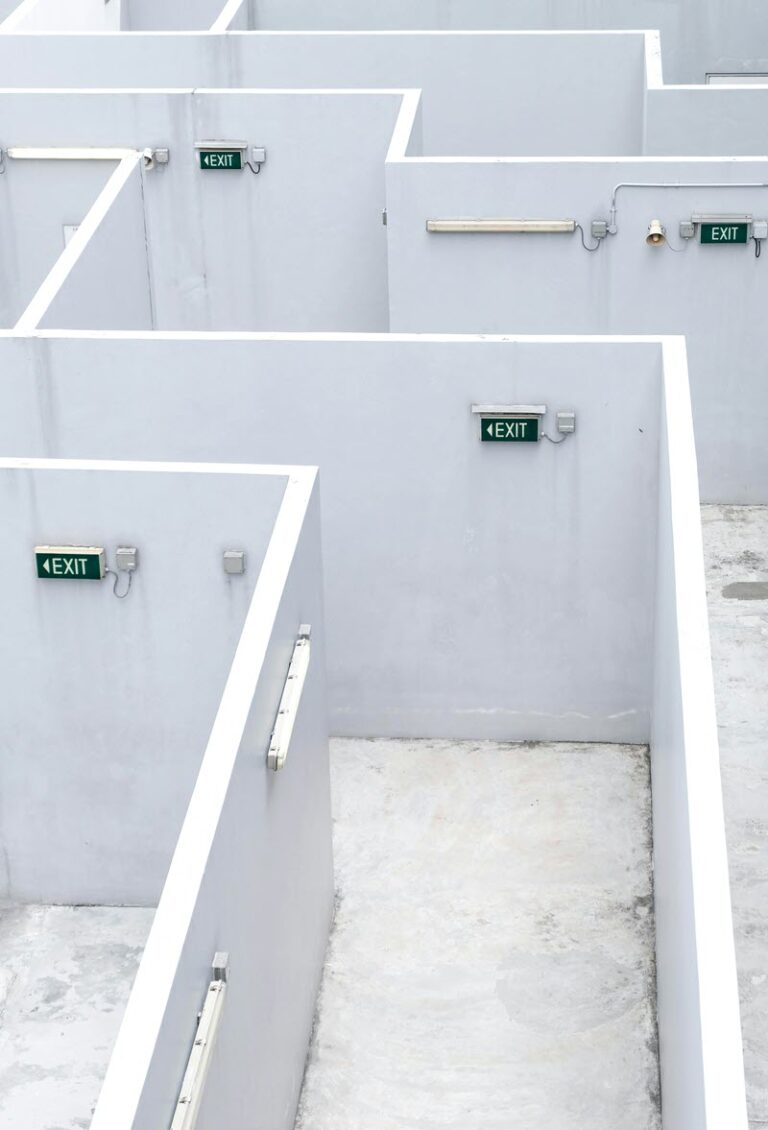
Maze of white corridors with numerous exit signs
Photo by Rayson Tan on Unsplash

Feeling Trapped

The need to pay your rent, your mortgage, your electricity bill, feed yourself, feed your kids, find the money to pay for your CPD, can make you feel trapped with no other option but to keep going.  It can feel relentless.  But still we go on, reluctant to speak openly due to fear, shame and guilt.  This means many people continue to struggle alone until their health, relationships, and confidence are deeply affected.

Our 'Always On' World

In this always-on world it is hard to step back, take time for yourself, and genuinely switch off from work.  The ever-growing email inbox that seems to have taken on a life of its own, the pinging of LinkedIn notifications, the reminders from the seemingly hundreds of other apps you may use for work, can all seem impossible to escape.  It’s all well and good to say “turn off your phone”, but what if it’s how your kids contact you when they are out with friends?  Or you care for an elderly parent and you’ll get pinged if they are in difficulty and need help?  Switching off is rarely that straightforward.

The consequences of workplace stress and burnout can be far‑reaching, leading to withdrawal from social contact, reduced motivation, and increased risk of depression. People may begin to believe they are “not cut out” for their job, when in reality they have been carrying more than any human nervous system can sustain.

Recovery

Recovery begins with naming burnout without shame.  Counselling therapy provides a confidential space to explore both external pressures and internal patterns such as perfectionism or people‑pleasing. It helps you reconnect with your individual needs, rebuild sustainable routines, and challenge the belief that burnout reflects personal inadequacy.  It is not a sign of weakness. It is a sign that something in your environment, workload, or support system needs care, attention, and change.

If you recognise yourself in this and would like to talk things through in a safe, confidential space, do contact me and we can have a chat about how we can work together to turn things around for you.

Catriona Standingford, registered counsellor therapist online and in-person in Chepstow, South East Wales

Catriona Standingford

Therapist | Counsellor | Coach | Educator

Share this article:

My professional accreditations and credentials

Catriona Standingford Registered Member 420820 MBACP logo
Catriona Standingford Member of NCPS
Catriona Standingford Trauma Informed Practitioner Counsellor Therapy MBACP

Are you in an emergency?

Are you currently experiencing an emergency or major crisis? Are you considering serious self-harm? Please seek immediate help from your GP, visiting your nearest A&E or dialing 999.

If you would like to have someone listen to you, you can also contact the Samaritans immediately on 116 123.  They are available 24 hours a day, 365 days a year.